Choosing Between SaaS and Custom Development: 5 Essential Factors That Decide It
Published on April 12, 2026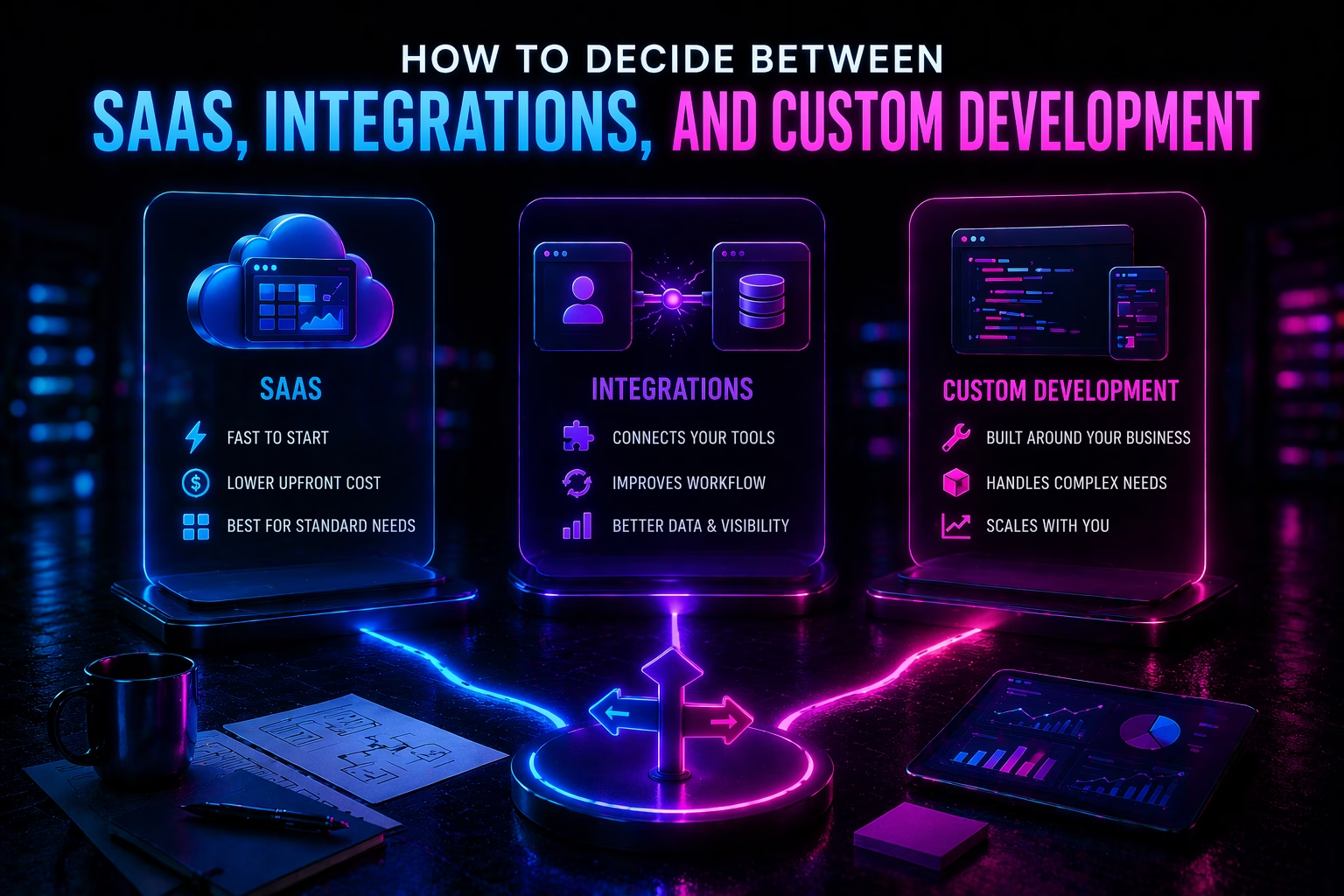
Choosing between SaaS and custom development is one of the most consequential software decisions a growing business makes. Get it right and you have a system that fits your operations, scales with your growth, and creates real competitive advantage. Get it wrong and you spend years fighting your own tools — or rebuilding from scratch at significant cost.
DIGIDMN helps businesses navigate the process of choosing between SaaS and custom development with clarity and honesty. We do not have a vested interest in building something you do not need. We have a vested interest in getting it right.
Why Choosing Between SaaS and Custom Development Is Harder Than It Looks
The surface-level answer to choosing between SaaS and custom development seems obvious. SaaS is faster and cheaper upfront. Custom development costs more but fits better. In practice, neither statement is reliably true across all contexts.
Some SaaS platforms become extremely expensive at scale. Some custom builds are delivered quickly and at lower total cost than three years of SaaS subscriptions. The real process of choosing between SaaS and custom development requires honest analysis of your specific business — its workflow complexity, growth trajectory, integration requirements, and long-term data ownership needs.
Gartner’s SaaS research consistently highlights that the total cost of SaaS ownership increases sharply with business complexity — a critical insight when choosing between SaaS and custom development for a growing operation.
There is also a third option that often gets overlooked: integrations. Choosing between SaaS, integrations, and custom development sometimes means the answer is none of the above alone — it is a combination of existing SaaS tools connected through custom integration logic. DIGIDMN evaluates all three paths before recommending any of them.
Factor 1: How Unique Are Your Business Processes?
The most important factor when choosing between SaaS and custom development is process uniqueness. If your business processes are broadly standard — general accounting, basic CRM needs, email marketing — SaaS makes sense. These tools were built for exactly these needs, and buying standard software for standard processes is almost always the right call.
But if your operational workflows are specific to your industry, your service model, or your internal structure, SaaS will force compromises. You will find yourself working around the software’s limitations rather than through them. That is the first clear signal that choosing between SaaS and custom development should lean toward custom — or at minimum toward a customisable integration layer.
DIGIDMN’s discovery process maps your actual workflows before making any recommendation. Choosing between SaaS and custom development without that mapping produces guesswork, not strategy.
Factor 2: What Does Your Existing Tech Stack Require?
Integration complexity is the second major factor when choosing between SaaS and custom development. A SaaS tool that works brilliantly in isolation but cannot connect cleanly to your other systems creates a new problem — manual data transfer, inconsistent records, and reporting that never quite adds up.
When choosing between SaaS and custom development, always evaluate whether the tool connects reliably to what you already have. Does it expose the APIs your other systems need? Can it receive data as well as send it? Can you control how data is structured at the integration layer?
Sometimes when choosing between SaaS and custom development, the right answer is a thin custom integration layer that connects two or more SaaS tools — giving you the speed of SaaS with the data flow of a purpose-built system. DIGIDMN designs these hybrid architectures frequently.
Factor 3: What Does the Real Cost Look Like Over Three Years?
Short-term cost is the most common mistake made when choosing between SaaS and custom development. SaaS feels cheaper because the upfront investment is low. Custom development feels expensive because the initial number is larger.
But the correct comparison when choosing between SaaS and custom development is total cost of ownership over three to five years. SaaS costs compound: per-user pricing, tier upgrades as you grow, multiple subscriptions across disconnected tools, and the hidden cost of staff time spent working around platform limitations.
Custom development has a larger upfront cost but predictable running costs, no per-user pricing at scale, and a system that improves rather than constrains as usage increases. IBM’s software development research supports this — long-term total cost of ownership often favours custom development for operational systems used by growing teams. DIGIDMN models this comparison honestly when choosing between SaaS and custom development with clients.
Factor 4: Who Owns and Controls Your Data?
Data ownership is an increasingly important consideration when choosing between SaaS and custom development. With SaaS, your operational data lives on someone else’s infrastructure, structured in their schema, accessible on their terms, and exported in formats they control.
For most standard workflows this is acceptable. But for businesses that depend on proprietary data — customer intelligence, pricing models, operational benchmarks, or sensitive compliance records — choosing between SaaS and custom development has a different answer. Custom development gives you full ownership and control over how your data is structured, stored, accessed, and used.
If your data is a strategic asset, that is worth significant weight when choosing between SaaS and custom development.
Factor 5: Where Is Your Business in Two Years?
The final factor when choosing between SaaS and custom development is growth trajectory. A tool that fits today may not fit the business in 24 months. SaaS platforms built for SMEs often hit architectural limits as companies scale. Custom-built systems, designed with scalability as a requirement, grow alongside the business.
When choosing between SaaS and custom development, DIGIDMN projects your operational complexity two to three years forward. If growth will require features, data volumes, or workflow complexity that the SaaS platform cannot support, investing in custom development earlier produces better long-term outcomes.
The worst outcome when choosing between SaaS and custom development is rebuilding from scratch after two years of SaaS lock-in — losing both time and data in the transition.
How DIGIDMN Guides the Decision
DIGIDMN approaches choosing between SaaS and custom development as a strategic consulting exercise before any build conversation begins. We map your workflows, analyse your integration requirements, model total cost of ownership, and give you an honest recommendation — even when that recommendation is to use SaaS rather than build custom.
Our goal is not to sell development hours. It is to make sure the decision you make when choosing between SaaS and custom development is right for your business. That means sometimes recommending SaaS, sometimes recommending custom, and sometimes recommending a hybrid of both connected through purpose-built integration logic.
That clarity is what makes DIGIDMN a useful strategic partner when choosing between SaaS and custom development, not just a vendor waiting for a brief.
Get Help Choosing Between SaaS and Custom Development
Most businesses make the decision of choosing between SaaS and custom development based on incomplete information — a sales demo, a price quote, or an assumption about what is standard practice. DIGIDMN provides the structured analysis that makes this decision strategic rather than reactive.
If you are currently choosing between SaaS and custom development for an operational challenge, get in touch with DIGIDMN for an honest evaluation. Or browse the blog for more thinking on software strategy and system design.