Business Data Visibility: 6 Powerful Ways DIGIDMN Builds It Into Every System
Published on April 12, 2026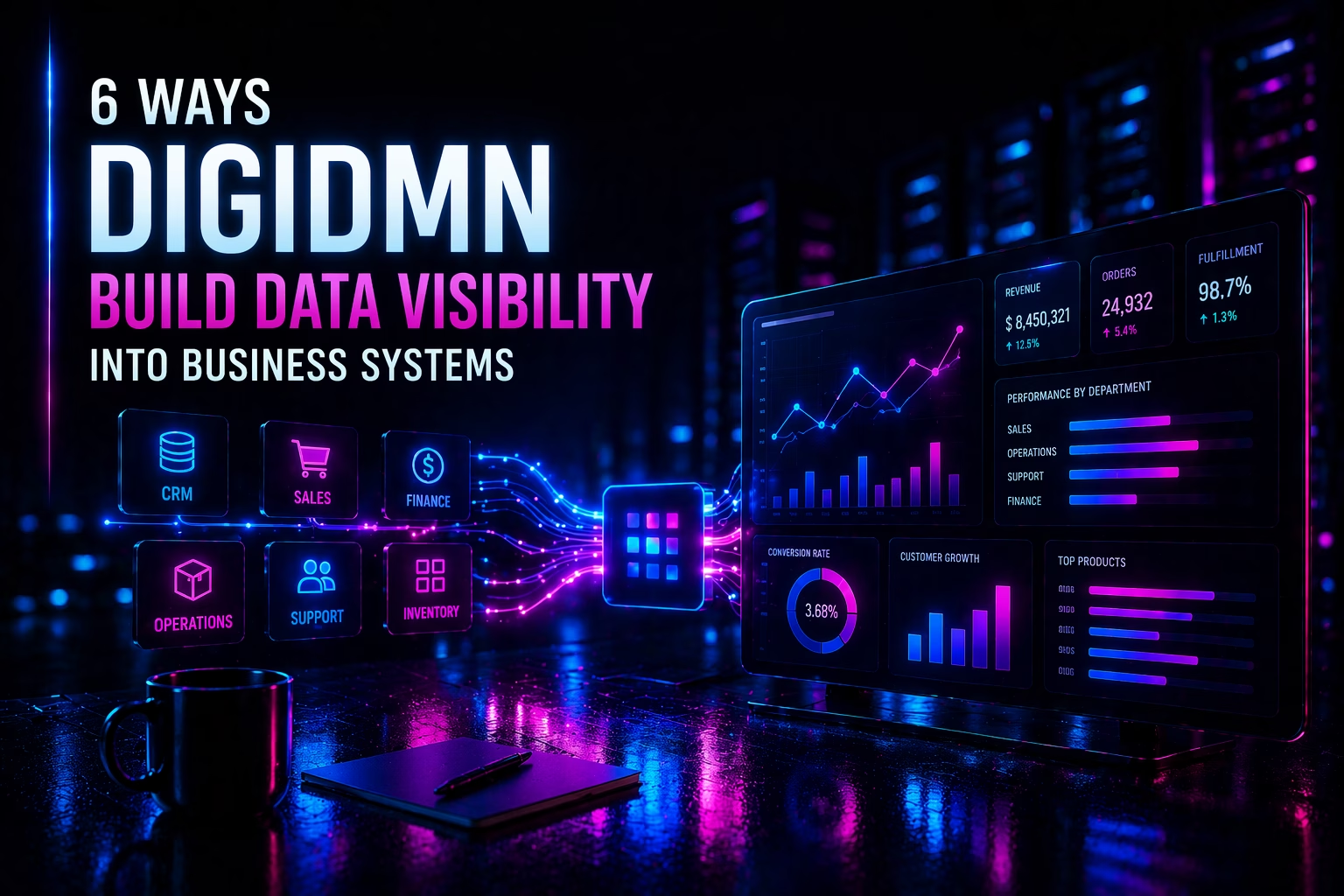
Business data visibility is the difference between a leadership team that manages by instinct and one that manages by fact. When operational visibility is strong, every important metric is accessible, current, and reliable. When it is weak, the business operates on delayed, incomplete, or simply wrong information — and makes decisions to match.
DIGIDMN treats business data visibility as a non-negotiable feature of every system we build. It is not a reporting module bolted on at the end. It is designed into the architecture from the start — because a powerful system that nobody can see clearly is only half a system.
Why Business Data Visibility Matters More Than More Tools
Many businesses facing operational uncertainty respond by adding more software. Another dashboard. Another reporting tool. Another data platform. But business data visibility is not a product you buy — it is a quality of your systems architecture. More tools without better architecture typically produce more fragmentation, not better operational visibility.
The businesses with the strongest data visibility are not the ones with the most tools. They are the ones that have structured their data well, connected their systems cleanly, and surfaced the right information to the right people at the right time.
Tableau’s business intelligence research consistently finds that business intelligence and operational visibility make decisions two to three times faster than those relying on manual reporting cycles — a compounding operational advantage that grows over time.
Way 1: Connecting All Data Sources Into a Single Operational View
The first thing DIGIDMN builds into every engagement is a connected data architecture. Business data visibility starts with consolidation — bringing operational data from CRMs, finance platforms, delivery systems, and operational databases into a unified layer where it can be queried, reported, and actioned together.
Most businesses have significant amounts of useful operational data. What they lack is the integration layer that makes it available through a unified reporting layer. DIGIDMN builds that layer as a core component, not an add-on. The result is a single view where business data visibility spans every operational domain.
Way 2: Real-Time Operational Dashboards That Inform Decisions Immediately
Business data visibility delivered in real time changes the speed at which a business can respond. When status, performance, and exception data is available as it happens — not at the end of the day or week — leadership can act before small problems become large ones.
DIGIDMN builds real-time dashboards as a standard output of every system we deliver. Live operational dashboards means your team always has an accurate operational picture — without requesting reports, waiting for compilation, or trusting data that is already out of date.
These dashboards are designed around actual decisions. Operational visibility is only useful when it surfaces the metrics that change how your team acts.
Way 3: Automated Alerts That Surface Problems Before They Escalate
Real-time visibility should not require anyone to check a dashboard to find problems. DIGIDMN builds alert logic into every system — so when a metric crosses a threshold, a task goes overdue, or an anomaly appears in the data, the right person is notified automatically.
This proactive approach to monitoring operations turns your systems from passive record-keepers into active operational monitors. Instead of discovering a problem in a monthly review, you are told about it the moment it appears. That is real-time visibility working at its most valuable.
Way 4: Financial and Margin Clarity Without the Manual Work
Financial visibility is among the most requested outcomes DIGIDMN delivers. Most growing businesses know their revenue. Fewer have clear, reliable, real-time visibility into margin — by client, project, service line, or region.
Building financial visibility requires connecting operational data to financial data in a way that produces margin transparency automatically. DIGIDMN designs these connections into platform architecture — so that when a job is completed, the financial visibility is updated immediately, without manual reconciliation.
McKinsey’s financial analytics research highlights that businesses with real-time financial business data visibility consistently outperform peers in pricing decisions and resource allocation — direct commercial impacts of better data architecture.
Way 5: Customer and Pipeline Transparency Across Every Touchpoint
Business data visibility extends to customer relationships. How is each client relationship performing? Where are potential churn risks? Which accounts have unresolved issues? What does the pipeline look like for the next 60 days?
DIGIDMN builds customer visibility into CRM integrations, client portal systems, and account management dashboards. The result is a team that can see every customer relationship in full context — and manage it proactively rather than reactively.
Customer-facing visibility also improves the client experience directly. Clients who can see their own project or service status through a well-designed portal feel more in control and communicate better.
Way 6: Scalable Data Architecture That Maintains Business Data Visibility as You Grow
Business data visibility that works at fifty customers often breaks at five hundred. DIGIDMN designs data architectures that maintain visibility across operations at scale — through proper data modelling, efficient query design, appropriate caching, and reporting layers that do not degrade as data volumes increase.
Growing businesses frequently discover that their early-stage reporting stops working under load. DIGIDMN prevents that by designing scalable reporting capabilities as a scalable capability from the start — not retrofitting it after the system is already straining.
How DIGIDMN Makes Business Data Visibility a Standard Feature
DIGIDMN’s approach to business data visibility is architectural rather than cosmetic. We do not add dashboards as a final step. We design the data structures, integration points, and reporting layers that make business data visibility reliable and automatic from the moment a system goes live.
Every system we deliver includes defined business data visibility requirements — which metrics matter, who needs to see what, at what frequency, and through what interface. That deliberateness is what makes business data visibility a sustainable operational asset rather than a feature that fades after launch.
If your business is making decisions with incomplete or unreliable information, talk to DIGIDMN about building real business data visibility into your operations. Or read more on the blog for deeper thinking on data strategy and system design.