What to Fix Before You Invest in Custom Software Development
Published on April 12, 2026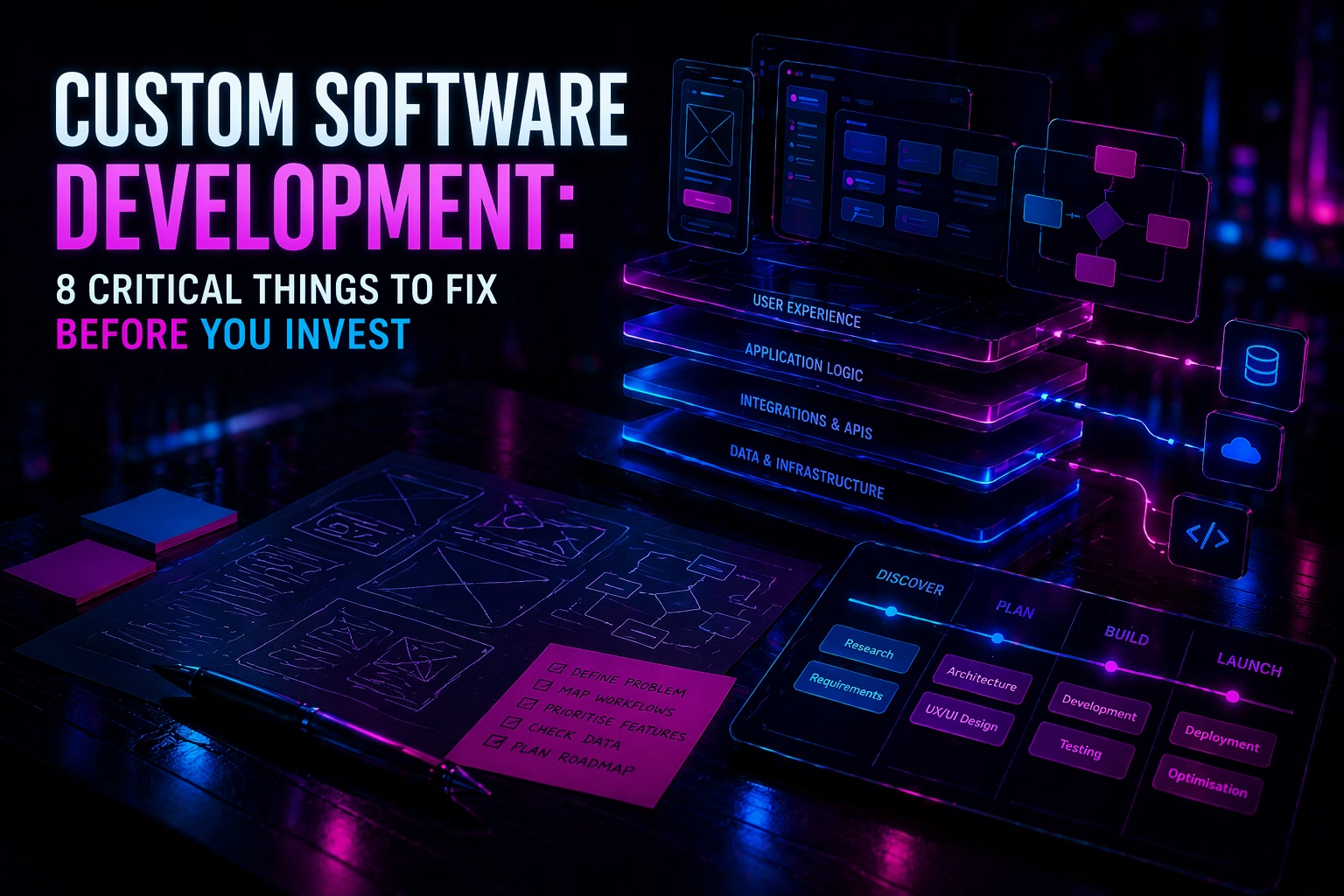
Custom software development can unlock major operational advantages for growing businesses, but only when the project starts on the right foundation. Too many companies invest in building systems before fixing the underlying issues that caused the need for software in the first place.
That is where things go wrong.
Budgets increase, timelines stretch, requirements shift, and the final product does not fully solve the real business problem. Not because development failed, but because the foundation was unclear from the start.
Before investing in custom software development, it is essential to fix the issues that create risk, confusion, and misalignment.
This is what separates successful software projects from expensive mistakes.
Why Custom Software Projects Fail Before They Even Start
Most custom software development failures do not happen during development.
They happen before a single line of code is written.
Businesses often move too quickly into:
- feature lists
- budgets
- timelines
- technology decisions
Without fully understanding:
- the real problem
- the actual workflow
- the data structure
- the user experience
- the long-term roadmap
That creates a mismatch between what gets built and what the business actually needs.
1. The Problem Is Not Clearly Defined
The biggest mistake in custom software development is solving the wrong problem.
Many businesses describe what they want to build instead of clearly defining what is broken.
For example:
- “We need a dashboard”
- “We need a system”
- “We need automation”
These are not problems. They are assumptions about solutions.
A stronger starting point is:
- We cannot see performance without manual reporting
- Our workflow depends on too many manual steps
- Our systems do not communicate properly
If the problem is unclear, the software will be misaligned from the start.
2. The Actual Workflow Is Not Understood
Custom software development should reflect how the business actually operates.
Not how people think it operates.
Most businesses have hidden complexity in their workflows:
- informal steps
- exceptions
- manual workarounds
- dependency on specific people
If these are not mapped properly, the software will be built on assumptions instead of reality.
That leads to friction after launch, even if the system looks technically correct.
3. Expectations Are Unrealistic
Another common issue is expecting custom software development to solve everything at once.
This creates:
- bloated scope
- conflicting priorities
- slow delivery
- increased cost
Strong projects define:
- what must be included
- what can wait
- what should not be included
Clarity here protects both the budget and the outcome.
4. There Is No Clear Ownership
Custom software development requires internal ownership.
Someone needs to:
- make decisions
- validate requirements
- represent business priorities
- resolve ambiguity quickly
Without this, the project becomes slow and inconsistent.
Developers end up guessing instead of building with confidence.
5. Data and System Dependencies Are Ignored
Many businesses underestimate how much custom software development depends on data.
Common issues include:
- duplicate data
- inconsistent formats
- missing information
- disconnected systems
If these are not addressed early, they create major challenges during development.
This is where API & Systems Integration often becomes essential.
6. Priorities Are Not Structured Properly
Not every feature matters equally.
But many projects treat everything as urgent.
This leads to:
- slower progress
- confusing decisions
- weaker outcomes
A strong custom software development approach separates:
- core functionality
- secondary features
- future improvements
This keeps the project focused and practical.
7. User Experience Is Not Considered Early
Many businesses focus heavily on functionality but overlook usability.
A system can be technically powerful and still fail if it is difficult to use.
Poor UX leads to:
- low adoption
- workarounds
- inefficiency
This is why UX/UI Design should be part of the process from the beginning.
8. There Is No Clear Roadmap
Custom software development should not be treated as a one-time project.
It should be part of a roadmap.
That roadmap should define:
- phase one delivery
- future integrations
- scaling requirements
- ongoing improvements
Without this, the system becomes difficult to evolve.
What Growing Businesses Actually Need Instead
Before investing in custom software development, businesses need clarity.
That usually includes:
- a clearly defined problem
- a mapped workflow
- structured priorities
- cleaner data understanding
- a realistic roadmap
This is where Digital Strategy Consulting becomes valuable.
It ensures the system is built around the business, not the other way around.
What to Do Before You Invest
Before starting custom software development, take time to:
- define the real problem
- map the workflow
- identify bottlenecks
- clarify ownership
- review data structure
- prioritise features properly
This reduces risk significantly.
It also ensures that the investment actually solves something meaningful.
Final Thoughts
Custom software development can be one of the most valuable investments a business makes.
But only when it is approached with the right foundation.
The goal is not just to build software.
The goal is to build a system that improves how the business operates.
The businesses that fix these issues early are the ones that create systems that scale, perform, and deliver real long-term value.
DIGIDMN
Software Engineering & Enterprise Development