Disconnected Software Systems: 9 Costly Ways They Slow Down Growing Companies
Published on April 12, 2026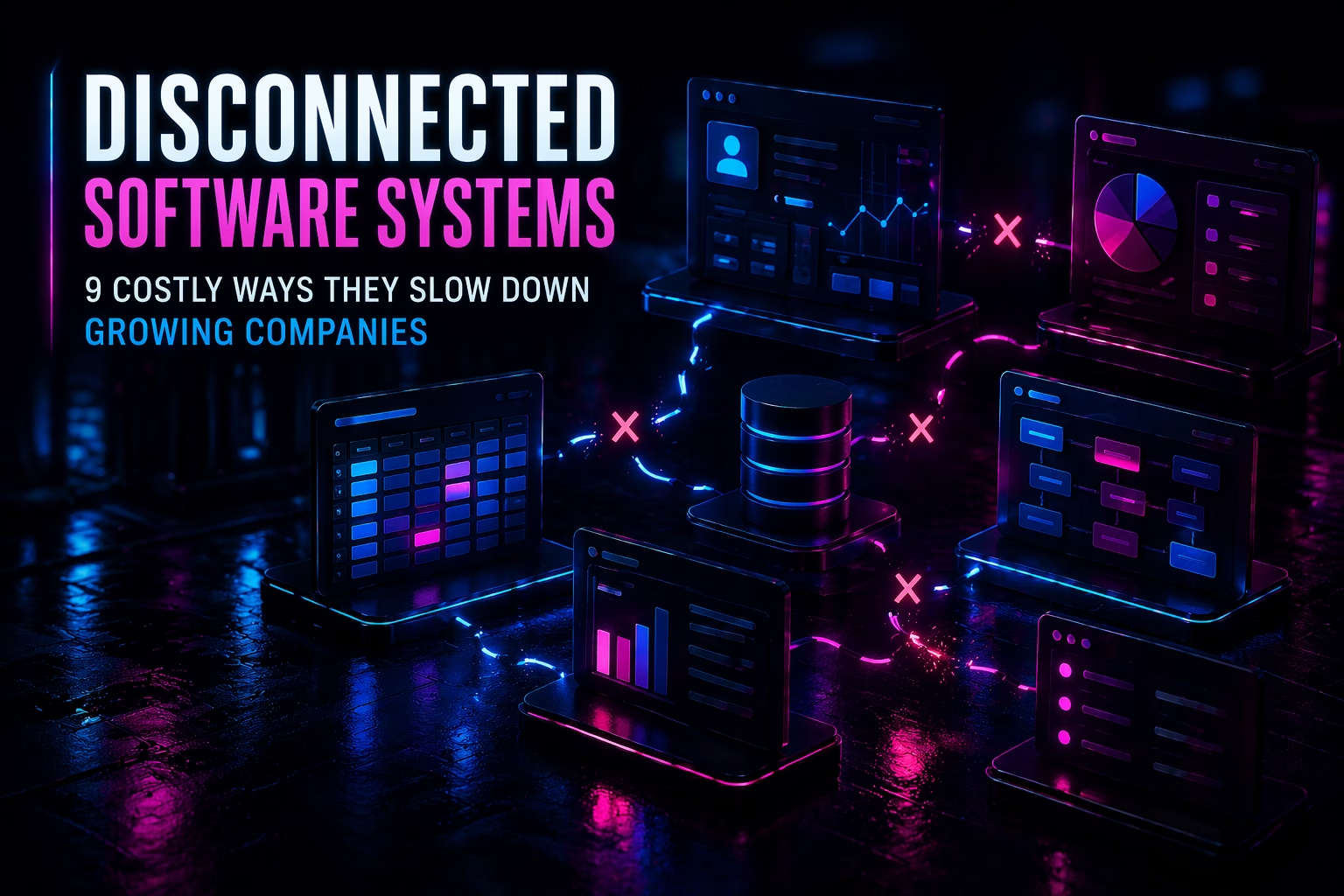
Disconnected software systems are one of the most common reasons growing businesses feel busy, well-equipped, and still inefficient at the same time. On the surface, the business may appear to have the right tools in place. There may be a CRM, a finance system, a project platform, a website, reporting spreadsheets, and several specialist tools across departments. The problem is that these systems often do not work together in a meaningful way.
When software systems are disconnected, teams compensate manually.
They copy information between platforms, follow up by email or chat, rebuild reports by hand, and spend too much time checking whether the data in one system matches the data in another.
That creates hidden friction across the business.
What looks like a software stack often behaves more like a collection of isolated tools. Over time, that weakens efficiency, visibility, accountability, and the business’s ability to scale cleanly.
This is where disconnected software systems stop being a technical inconvenience and become a business performance problem.
Why Disconnected Software Systems Seem Manageable at First
There is a reason disconnected software systems are so common.
Most businesses do not build fragmentation deliberately. It happens gradually.
One tool solves a sales need. Another solves finance. Another helps with project delivery. Another handles reporting. Over time, the business adds systems as new needs appear.
At first, that may not seem like a problem.
A smaller business can often get away with manual coordination between systems because team size, complexity, and transaction volume are still manageable.
The problem appears when growth increases pressure on the gaps between those tools.
That is usually when businesses start realising they are not only using software. They are also spending significant effort compensating for disconnected software systems.
When Separate Tools Stop Being Helpful and Start Creating Friction
Disconnected software systems become harmful when the business depends on them for workflows that need consistency, speed, and visibility.
That often includes:
- Managing customer data
- Tracking project or service delivery
- Handling internal handoffs
- Producing business reporting
- Managing approvals and updates
- Coordinating work across departments
At that point, the issue is no longer just that the software is separate.
The issue is that the business is relying on people to manually bridge the gaps between systems that should be working together more effectively.
1. Data Has to Be Moved Manually
One of the clearest signs of disconnected software systems is repeated manual transfer of information.
A team enters information into one platform, then recreates part of it somewhere else because another department works in a different tool. Data may be copied into spreadsheets, pasted into reports, or sent through chat and email because the systems are not properly connected.
That wastes time and increases the risk of mistakes.
It also means operational speed depends too heavily on human follow-through instead of process structure.
2. Teams Work From Different Versions of the Truth
Disconnected software systems often create conflicting answers to the same business question.
Sales may think a customer is at one stage. Operations may have a different status. Finance may be working from another version entirely. Leadership may be looking at a report built from data that is already outdated.
That makes decision-making slower and less reliable.
When teams cannot trust that they are looking at the same reality, the business loses one of the most important ingredients of effective execution: shared visibility.
3. Reporting Becomes Delayed and Fragile
Disconnected software systems make reporting far harder than it should be.
Instead of information being visible in a structured way, someone has to pull data from multiple platforms, check for inconsistencies, clean the output, and manually assemble the report.
That creates recurring pressure across the business.
Leadership ends up waiting for visibility that should have been available much sooner. Teams spend time producing reports instead of acting on insight.
This is also why better data visibility becomes so important in growing businesses.
4. Customer Experience Becomes Less Consistent
Customers usually do not see the software architecture directly.
But they absolutely feel the effects of disconnected software systems.
That often shows up as:
- Repeated requests for the same information
- Inconsistent updates from different teams
- Delays between stages of service delivery
- Communication that feels less coordinated
- A slower and less polished overall experience
Even when internal teams are working hard, the customer experience can still feel fragmented if the systems underneath the work are not aligned.
5. Accountability Becomes Harder to Maintain
Disconnected software systems often weaken accountability because ownership becomes harder to track.
If tasks move across disconnected platforms, it becomes easier for work to sit between teams without clear visibility. One system may show an update, but another may not. One department may assume the next step has happened, while another is still waiting.
The result is ambiguity.
That ambiguity makes delays harder to diagnose and performance harder to improve.
6. Automation Becomes Difficult or Incomplete
Many businesses want workflow automation, but disconnected software systems make that harder to achieve properly.
Automation depends on structure.
If the underlying tools do not communicate clearly, automation usually becomes partial, brittle, or dependent on manual intervention. That defeats much of the value automation is supposed to create.
This is one reason why businesses dealing with disconnected software systems often need stronger API & Systems Integration or more deliberate Business Process Automation before automation can create meaningful value.
7. Leaders Lose Real-Time Visibility
Growing businesses need clearer operational visibility, not more guesswork.
Disconnected software systems weaken that visibility because important information sits across too many separate tools. Leadership then depends on manual summaries, status updates, and recurring clarification instead of seeing what is happening directly.
That slows strategic decision-making.
It also makes it harder to identify bottlenecks, track performance properly, or respond quickly when something starts going wrong.
8. Scale Creates More Complexity Instead of More Capacity
Growth does not solve disconnected software systems.
It usually amplifies them.
As businesses add more customers, more staff, more service lines, or more workflow stages, the number of handoffs and dependencies increases. If the systems are already fragmented, that additional complexity creates even more operational friction.
Instead of gaining momentum through growth, the business becomes more dependent on manual coordination across disconnected platforms.
This is often the point where businesses realise they need stronger digital foundations rather than just more tools.
9. Software Spend Increases Without Equivalent Efficiency
One of the most frustrating effects of disconnected software systems is rising technology spend without matching operational improvement.
The stack grows. More tools are added. Costs increase. Teams still chase updates manually, rebuild reports, and duplicate work.
At that stage, the issue is not whether the business has enough software.
The issue is whether the systems are connected in a way that actually supports how the business operates.
Why This Problem Gets Worse Over Time
Disconnected software systems often fail slowly.
They do not always create one dramatic breakdown. Instead, they create ongoing friction in small ways:
- a duplicated record here
- a missing update there
- a delayed handoff
- a report that takes too long to prepare
- a customer interaction that feels less coordinated than it should
Over time, those small points of friction accumulate.
The business becomes more dependent on effort than structure, and more dependent on staff coordination than system design.
That is why disconnected software systems become especially damaging during growth phases.
What Growing Businesses Actually Need Instead
When disconnected software systems start slowing the business down, the answer is not always to replace every platform at once.
The first step is understanding how information should move and where the real breakdowns are happening.
In many cases, businesses need:
- better system integration
- clearer workflow design
- centralised visibility
- stronger reporting structure
- automation of repetitive handoffs
- more deliberate digital planning
This is often where services such as Digital Strategy Consulting, API & Systems Integration, and Custom Software Solutions become highly valuable.
What to Do If Your Business Has Disconnected Software Systems
If these signs sound familiar, start by identifying:
- where data gets copied manually
- which systems hold overlapping information
- where reporting breaks down
- which handoffs rely too heavily on people
- where customers feel inconsistency
- which processes would improve if systems were better connected
Once that is clear, the business can decide whether the next step is simplification, integration, automation, or a more tailored systems approach.
The important point is this: disconnected software systems are not just a technical inconvenience.
They are often one of the clearest operational barriers to speed, visibility, and scalable growth.
Final Thoughts
Software should make a growing business easier to run, not harder to coordinate.
When systems are disconnected, the business ends up relying on manual fixes between tools that should have been working together more effectively.
That slows teams down, reduces visibility, weakens accountability, and makes growth more complicated than it needs to be.
The businesses that solve disconnected software systems early are often the ones that build better workflows, stronger reporting, and more resilient digital operations over time.
DIGIDMN
Software Engineering & Enterprise Development