Why Workflow Automation Becomes a Competitive Advantage
Published on April 12, 2026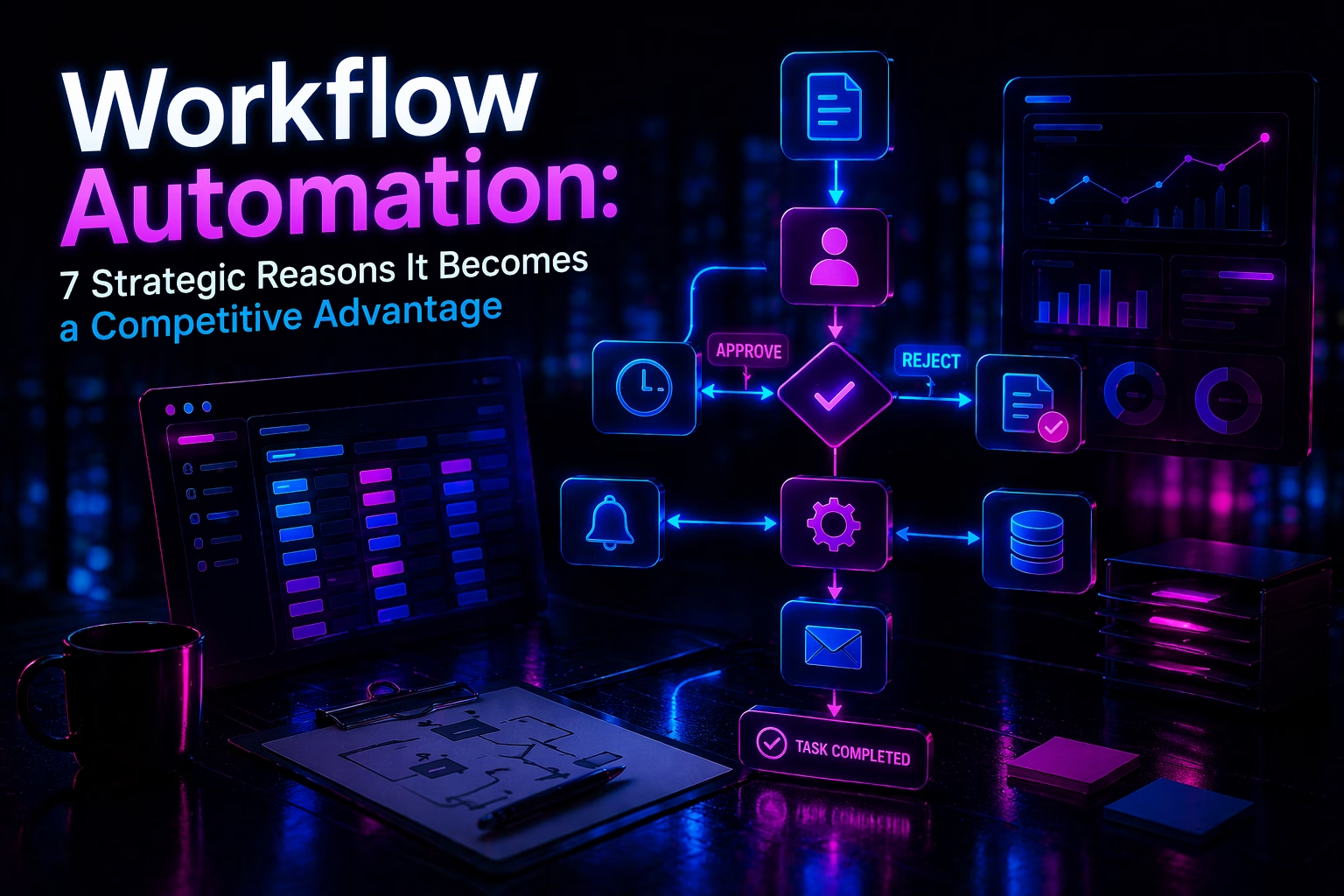
Workflow automation competitive advantage is not a buzzword. It is the measurable operational gap that opens between businesses that automate their processes and those that do not. Companies that build a genuine workflow automation competitive advantage process more volume, respond faster, make fewer errors, and scale without proportional cost increases. Those that do not are quietly falling behind.
DIGIDMN builds workflow automation competitive advantage into the operational fabric of every client we work with. Not as a single project, but as a strategic layer that improves how work moves through the business at every level.
What Workflow Automation Competitive Advantage Really Means
A workflow automation competitive advantage exists when automation allows a business to do things its competitors cannot match manually. That might mean processing five times the volume with the same team, responding to customers in minutes instead of hours, or producing financial reports in real time instead of waiting for end-of-month compilations.
The workflow automation competitive advantage is not about replacing people. It is about removing the repetitive, low-value work that prevents people from doing the high-value work that actually drives business growth. When your team is freed from manual admin, they focus on relationships, decisions, and execution — the things automation cannot do.
According to Harvard Business Review’s automation research, businesses that implement workflow automation consistently outperform peers on efficiency, customer satisfaction, and profit margins — all core dimensions of workflow automation competitive advantage.
Strategy 1: Automate the Approval Chain
One of the most common sources of workflow automation competitive advantage is eliminating approval bottlenecks. In most growing businesses, approvals — for purchases, proposals, invoices, or onboarding steps — travel through email chains and informal messages. Each step depends on someone being available, checking the right inbox, and remembering to follow up.
DIGIDMN builds approval workflows that route requests automatically, notify the right person at the right time, escalate if no action is taken, and update connected systems when approval is granted. That turns a process that took days into one that takes minutes — a direct and measurable workflow automation competitive advantage.
Strategy 2: Eliminate Manual Data Transfer Between Systems
Manual data transfer between systems is one of the most expensive hidden costs in growing businesses. A sale is logged in the CRM, then re-entered into the finance system, then copied into the delivery platform, then updated in the reporting spreadsheet. Every transfer takes time and introduces error.
Building workflow automation competitive advantage through integration means data enters once and flows automatically to every system that needs it. DIGIDMN designs integration architectures that eliminate that transfer overhead entirely — turning a workflow automation competitive advantage into hard cost savings.
Zapier’s workflow automation research shows that businesses lose an average of several hours per employee per week to manual data handling — hours that workflow automation competitive advantage strategies recover directly.
Strategy 3: Automated Customer Communication
Customer communication is an area where workflow automation competitive advantage is immediately visible to the outside world. When customers receive timely, accurate, and personalised updates automatically — order confirmations, progress notifications, invoice reminders, onboarding sequences — they perceive a more professional and attentive operation.
The business that communicates proactively wins against the one that is always catching up. DIGIDMN builds automated customer communication workflows that trigger on real operational events — not on someone remembering to send an email. That consistency is a powerful dimension of workflow automation competitive advantage.
Strategy 4: Automated Reporting and Dashboard Visibility
Most businesses still produce reports manually. Someone pulls data from multiple systems, cleans it, and assembles a view that is already outdated by the time leadership reads it. Workflow automation competitive advantage in reporting means that information is available continuously, not on a schedule.
DIGIDMN builds reporting automation as part of every workflow automation competitive advantage engagement. Dashboards that update in real time, alerts that trigger when metrics fall outside ranges, and scheduled summaries that arrive without anyone producing them — these turn reporting from a chore into a continuous strategic asset.
Strategy 5: Automated Service Delivery Workflows
Service businesses carry a particular workflow automation competitive advantage opportunity in their delivery processes. Every client engagement involves repeated steps — onboarding, task assignment, progress tracking, deliverable review, invoicing, and closure. When these steps run on a structured automated workflow, delivery becomes more consistent and less dependent on individual initiative.
DIGIDMN maps service delivery workflows and automates the structural elements — task creation, status progression, handoff notifications, and client updates — so that your team focuses on the work rather than on managing the process around the work. That is workflow automation competitive advantage applied directly to revenue operations.
Strategy 6: Error Reduction Through Structured Process Logic
Every manual process is a potential source of error. Human memory is fallible. Copy-paste introduces mistakes. Steps get skipped under pressure. Workflow automation competitive advantage reduces error rates by replacing human execution of routine steps with structured system logic.
DIGIDMN builds validation and enforcement logic into automated workflows. Required fields cannot be skipped. Dependent steps cannot proceed until prerequisites are complete. Data formats are enforced at entry. The result is a significant workflow automation competitive advantage in reliability and quality consistency.
Strategy 7: Scale Without Proportional Headcount Growth
The ultimate expression of workflow automation competitive advantage is the ability to grow revenue without growing costs at the same rate. When your operational processes are automated, additional volume flows through the same system without requiring additional manual labour at each step.
Businesses that depend on manual processes must hire more staff every time they grow. Businesses with strong workflow automation competitive advantage absorb growth through their systems. DIGIDMN designs automation architectures that are explicitly built for this — making scalability a structural feature, not an afterthought.
How DIGIDMN Builds Workflow Automation Competitive Advantage
DIGIDMN’s approach to workflow automation competitive advantage starts with process mapping. Before we automate anything, we understand how work currently moves through your business, where it slows down, where it breaks, and where the highest-value automation opportunities exist.
We then design and build the automation layer — whether that is workflow logic within custom software, integration between existing platforms, or entirely new operational systems. Every engagement is focused on the same outcome: delivering workflow automation competitive advantage that your business can feel, measure, and build on.
Talk to DIGIDMN about building workflow automation competitive advantage into your operations, or explore the blog for more on operational transformation.